Do I Need a Survey to Build a Pool in Pennsylvania?
Do I need a Land Survey In Order To Build a Pool in Pennsylvania?
Short answer: Yes. In most Pennsylvania municipalities, you need a boundary and/or topographic survey to get a pool permit. There is no state law that requires a survey prior to constructing a pool, but most municipalities require a survey as part of the permitting process. Pennsburg Borough, for example, requires both a boundary line survey and a topographic survey prepared by a registered surveyor or engineer before a pool grading permit can be approved.*
What Pennsylvania State Law Actually Says
Pennsylvania’s Uniform Construction Code (UCC) requires a building permit for any body of water more than 24 inches deep. That covers everything from a basic above-ground pool to a full in-ground installation. The UCC also requires a compliant safety barrier (fencing at least 48 inches tall) around the pool. *
The state code doesn’t spell out a survey requirement in those exact words. Instead, it leaves site-specific requirements, like surveys, setbacks, and grading plans, up to each municipality’s own building and zoning ordinances. That’s why the real answer to “do I need a survey” depends on where in PA you’re building.
How Local Ordinances Turn “Maybe” Into “Yes”
Most townships require a site or plot plan showing property lines, setbacks, and easements before approving a pool permit, and many require that plan to be a full survey, not just a sketch. Pennsburg Borough is a good example of how specific this can get: its Grading Ordinance (Chapter 53) lists pool installation as an activity requiring a grading permit, and the permit application must include a topographic survey and a boundary line survey, prepared by a registered surveyor or engineer.*
This pattern isn’t unique to Montgomery County. Homeowners in neighboring Bucks, Berks, and Lehigh Counties run into the same patchwork of local rules. Each municipality enforces its own grading and zoning ordinances on top of the statewide UCC, so a survey that satisfies one township’s permit office may not satisfy the next one over.
Why a Survey Protects You Beyond Just Getting the Permit
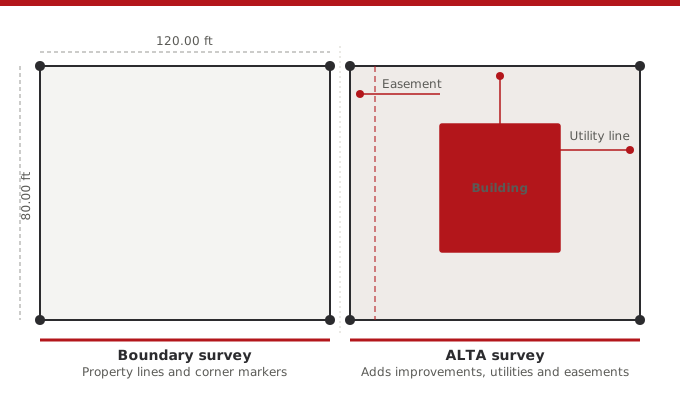
Even in a township where a survey isn’t strictly mandatory, skipping one is a gamble. A boundary survey shows you three things a tax map or deed never will accurately: exactly where your property line sits, where any utility easements run, and how far your pool must sit back from those lines under local setback rules.
A pool is a significant investment and the last thing you want to do is cut corners. A boundary survey will help protect you from many surprises. Build over a utility easement and the utility company can make you tear the pool out to reach their lines. Build over your property line, and you could end up in a legal fight with a neighbor that costs a lot more than the survey ever would have.
Even If You Don’t Think You Need a Survey, Your Contractor Probably Does
Every contractor has heard the adage “Measure twice, cut once”. Your pool contractor only wants to measure once and dig once. A professional boundary survey done by a firm like Horizon Engineering Associates lets them do that.
Pool construction doesn’t start when the first shovel hits the dirt, it starts when that first contract is signed. Contractors do most of their work behind the scenes. Your contractor must plan for property access, any on-site material storage, equipment placement, and more. All these factors are determined by reviewing a professional survey.
Homeowners often think they can avoid getting a boundary survey by using their deed or tax maps and that is simply not true. Deeds are often outdated and use informal measurements. Tax maps frequently use aerial imaging from sources like Google that are not precise.
Still Wondering If It Is Necessary?
Getting a boundary survey before any new construction is EXTREMELY important even if you think your property is a perfect square. An in-ground pool often costs between $50,000-$100,000. A quiet title lawsuit with a disgruntled neighbor could cost more than $10,000. How much are you willing to risk?
There are numerous factors that influence your true property boundary. Is it the shape you really think it is? Do you live in an older neighborhood that might rely on informal measurements? Do you have multiple neighbors whose lots are adjacent to your property?
All of these questions can be answered with a boundary survey done by a qualified professional like the ones at Horizon Engineering Associates.
Why Not Let the Contractor Handle Surveying?
A high-quality survey must be done by a licensed professional surveyor. This requires years of training and experience. Pool contractors often subcontract out the surveying portion of the job because they do not have the necessary qualified professionals on staff.
This results in two problems. The first is hidden costs. When you get a survey from a firm like ours, you know exactly what the price tag is. Transparency is extremely important to us.
The second problem is who controls the information? Some, not all, pool contractors will refuse to give you access to your survey documents when the project is finished. When you get your survey done from Horizon Engineering it’s yours to keep.
Why Choose Horizon Engineering for Your Land Survey?
The short answer: We’re really good at what we do.
The long answer: We’re really, really, good at what we do.
When you hire Horizon Engineering you’re getting access to a firm that has been doing surveying and land development design for more than 25 years. Our crew has experience with almost every type of property. Our experience lets us work quickly and effectively, saving you time and money. We usually know what your township’s permit office is going to ask for before you do, so your contractor can measure once, dig once, and actually start on schedule. Reach out for a straightforward quote on your pool survey.
*The information in this article is current at the time of publishing, but things may have changed. You should always consult an engineer to confirm the applicable rules and regulations.
Frequently Asked Questions
Does Pennsylvania require a survey to build a pool?
Not by name, no. There’s no single state law requiring a survey for every pool. But the PA Uniform Construction Code requires a permit for any pool deeper than 24 inches, and most municipalities ask for a survey or site plan as part of that application. So, in practice, you’ll almost always need one.
Does Pennsburg, PA require a survey to build a pool?
Does Pennsburg, PA require a survey to build a pool?
How long does it take to get a boundary survey in Montgomery County, PA?
Most boundary surveys in Montgomery County and the surrounding Bucks, Berks, and Lehigh County area are completed within two weeks of the site visit. More often than not, that is faster than your pool contractor’s own lead time for materials and scheduling. Older or heavily wooded lots in the Upper Perkiomen Valley can take a bit longer if property markers need to be located from scratch.
Can't I just use my deed or a tax map instead of getting a survey?
You can try, but it usually backfires. Deeds often rely on outdated or informal measurements, and tax maps are based on aerial imagery that isn’t precise enough for construction. Most PA municipalities and pool contractors won’t accept either as a substitute for a real survey.
What's the difference between a boundary survey and an as-built survey?
A boundary survey maps out your property lines, easements, and setbacks before you build. An as-built survey documents exactly where your finished pool ended up after construction, which some municipalities, Pennsburg included, require at specific stages of the project.
Who does boundary surveys for pool permits near Pennsburg, PA?
Horizon Engineering Associates, based right in Pennsburg, has handled boundary and topographic surveys for pool permits throughout the Upper Perkiomen Valley and greater Montgomery, Bucks, Berks, and Lehigh Counties for more than 25 years.